
The Life-Serving Boundaries Book

“I’ve now read Life-Serving Boundaries: 6 Practical Skills for Creating Thriving Relationships three times, and with each reading, my appreciation of its depth has shifted.
There is so much rich, practical material in this book, offered in such a friendly and accessible way, that I see endless possibilities for its use. I imagine creating an ongoing monthly study group where readers not only absorb the concepts but also practice the methods together. Life-Serving Boundaries is more than a book; it’s a guide for transforming how we relate—with clarity, compassion, and resilience.
What I applaud about Life-Serving Boundaries is that it helps readers build resilience, honor needs, and create healthier, satisfying connections. Other books on boundaries offer much-needed immediate relief with assertive no's, but they risk reinforcing oppositional dynamics instead of healing them.”
— Joan Flora, ICF Coach
Traditional ideas of boundaries focus on what you don't want--where setting a boundary is about closing off, pushing someone away, or expressing an angry "no" in the face of something unwanted. Such actions are often associated with being tough and may be accompanied by harsh judgments of yourself or others.
Life-Serving Boundaries is a practice that is designed to help you discern and direct energy toward what you do want. When you make decisions based on what truly is in accord with your values, what you don't want is naturally excluded most of the time.
Life-Serving Boundaries help you stay clear, stable, and focused on what truly serves life. They help you live a thriving life which includes contributing to the well-being of others in a sustainable and meaningful way.
When you trust yourself to set Life-Serving Boundaries, you become less vulnerable to reactivity. You have a sense of confidence that you can meet challenges and stay true to your deepest values. This allows you to stay heart-connected and consistently access wisdom and offer loving-kindness to yourself and others.
When boundaries are unclear, hyper-flexible, or rigid, a sense of threat can invade your relationships, and destabilize your ability to expand and grow. However, when boundaries are clear and consistent between people in any relationship or partnership, or even between you and yourself, you can relax into a sense of confidence that you can handle life's challenges.
Having clarity about Life-Serving Boundaries in relationships allows a greater sense of security and freedom. When you are clear about boundaries for yourself and others, you also know where you are free to play and grow together.
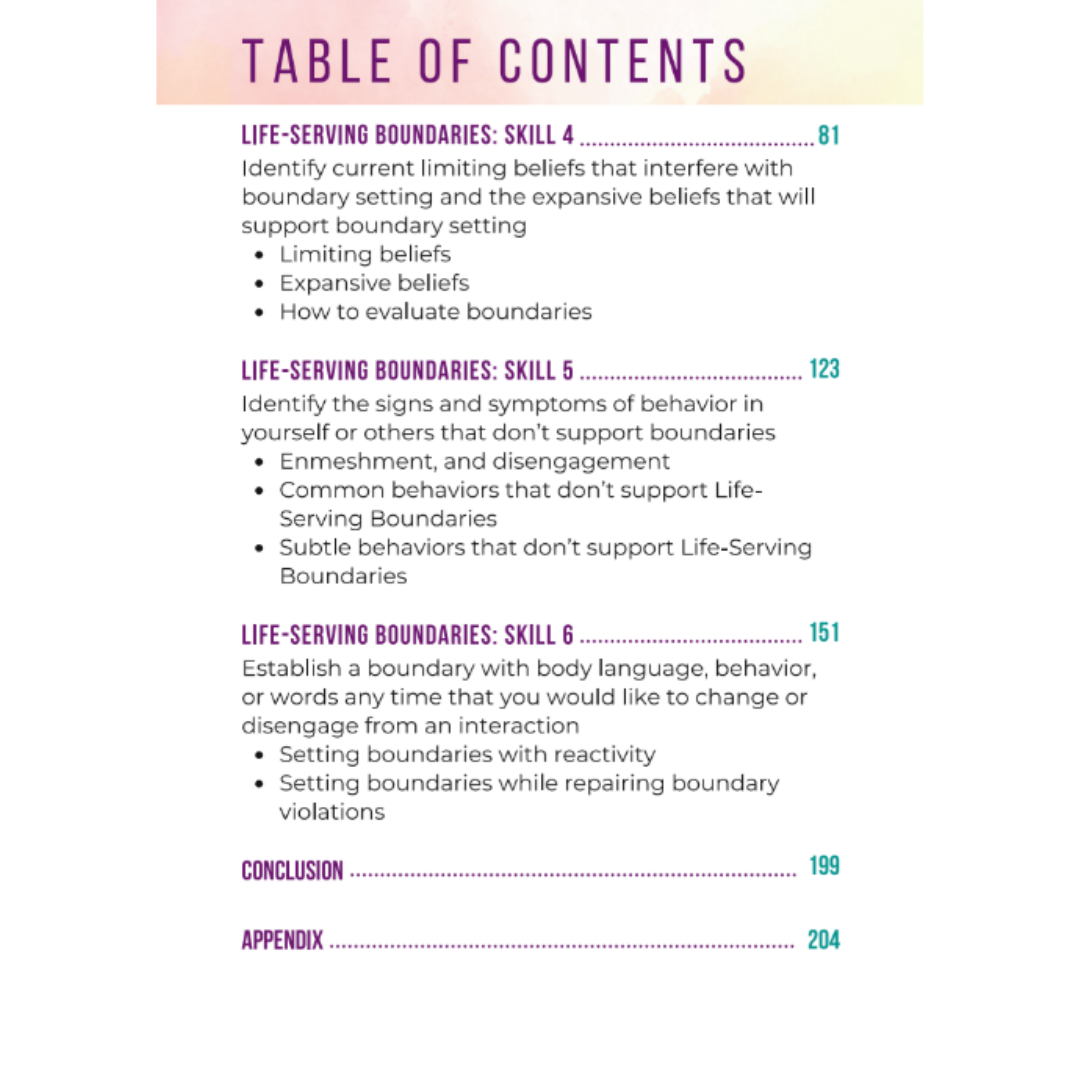
This book will help you learn to recognize and honor your own needs, speak clearly about them, understand the verbal and behavioral language of boundary setting, honor the needs of others without taking responsibility for them, and engage in healing work with regard to your experiences of boundary violations in the past.